


Motivation is a major goal for any manager or leader. As soon as they have managed to motivate the team members they coordinate (including themselves), no obstacle can get in the way of the achievement of the chosen objectives. Things clear up, self-confidence increases, solutions rise at every turn, all barriers “melt” in front of the momentum of a motivated team.
Well, how do we get into this condition?
The old “carrot and stick” methods don’t work today. Quickly, the conclusion was that if we treated the employees as servants, we shouldn’t be surprised that they acted like one… On the other hand, whatever carrot we hung, the performances of the “servants” arrived to be pretty much the same – mediocre! In search of other types of incentives, psychologists have “discovered” and proposed self-motivation.
Yet, to force someone to self-motivate is a contradiction in terms. Self-motivation is a prerogative of our own rationality, over which we cannot have any external control.
There are researchers who assert that it’s not even possible for a person to be motivated! They stand up the idea that motivation should be abandoned and that the solution lies actually in increasing the level of self-discipline.
Of the many theories that have emerged, the most famous remains that of the psychologist Abraham Maslow. Starting logically from its root, (motivation comes from the Latin word “motum” – movement) Maslow has done studies on normal, mature, whole, successful people and synthesized the resorts that set them in motion in the pyramid of human needs that bears his name:
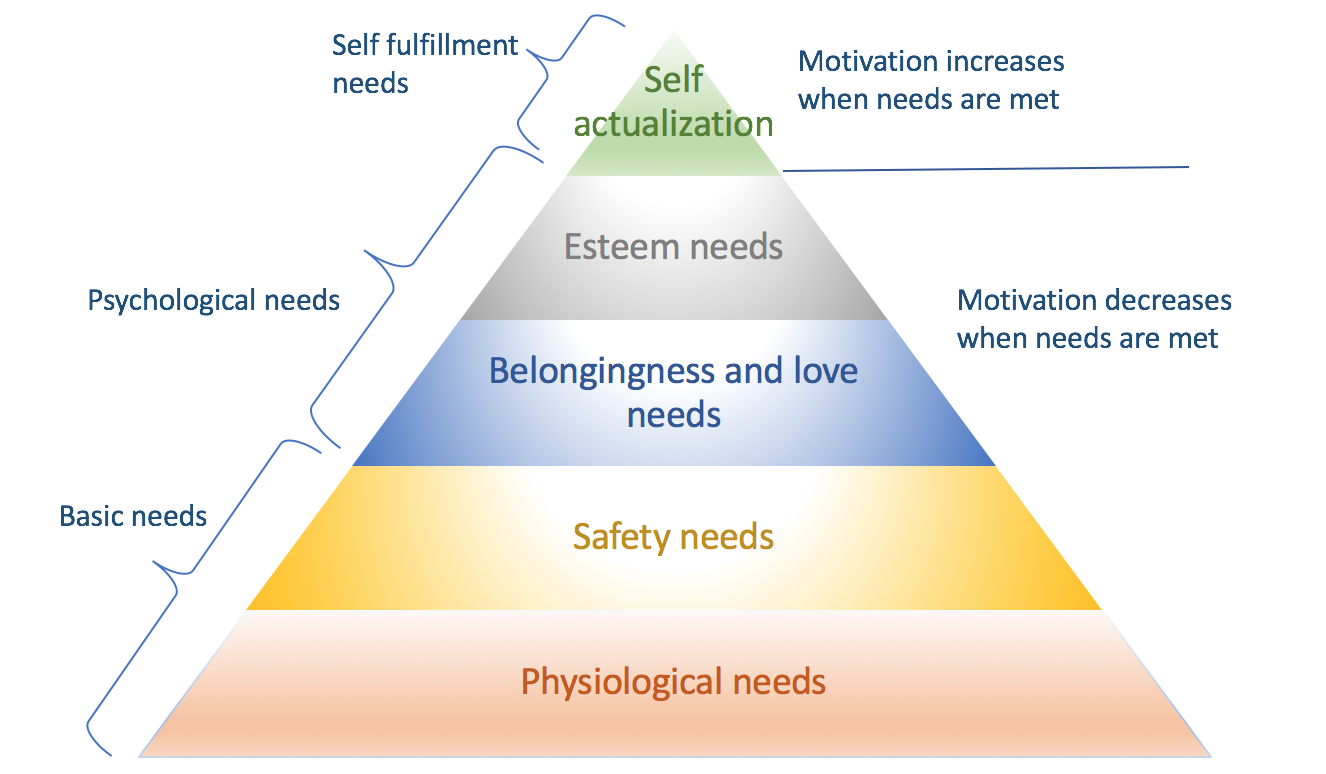
He also discovered something interesting: in human nature there is an intrinsically “call” to the top of the pyramid. But to get there, one will have to meet all other needs on the previous levels. This means that sooner or later, each of us (being an employee or not) will tend to the higher levels. If for the first four levels the needs are achievable, for the fifth, the enormous number (infinity) of options makes it unfulfillable! Rationally speaking, we will never satisfy our need for self-actualization!
So how can a manager motivate his people?
At first glance, quite simple: by discovering the needs or the level of their personal needs, followed by effective steps to facilitate them. How does the manager get that? That’s not that simple anymore. There are many factors that should be taken into account:
– the level of those needs
– the availability of communication from both sides and the types of communication channels that are used
– the personalities of those involved and the degree of their matching
– the approach methods and techniques as well as the type of the selected solutions
– the degree of alignment between the needs’ levels of the team members and the real possibilities of harmonizing
– the type and configuration of the objectives pursued.
Allow me to share some personal experiences.
Many leaders focus on the first 3 levels, where external incentives could bring some benefits. They do not realize the aspirations of subordinates for the higher levels (primarily because of not being aware of their own aspirations!). Once the needs are met here, we all naturally seek for something else. If we don’t realize this, we risk staying in a diffuse, permanent area of discontent that affects not only the performance of the professional activity but – and that is serious – the individual health, with consequences for the performance of the entire team.
For levels 4 and 5, material, external incentives are no longer valid – something else is needed. Here, nuances become valuable: self-esteem is not necessarily satisfied with prestige, notoriety or privileges, but mostly by being shown to that person that he/she is considered worthy/capable of making own choices. Many leaders use here the organization’s advancing system. It becomes counterproductive if applied somewhat mechanically: promotion is for no use to someone if real development options are restricted!
One of our frequent manifestations on the fifth level is the need to understand the immediate and also the deeper, more subtle meanings of our professional activity. We need to breakthrough and value our work. Here, a mentor would be very helpful…
Often, there is also a question of timing: it happens that the manager’s need for the particular position is different from the need of the employee who occupies it at a time. Misunderstanding is guaranteed and conflict is ready to burst at any moment. Of course, they would potentially line up – in time – towards the fifth level, but the manager wants it now! Sometimes, this is where the inspirational ability of leaders might be useful.
***
Obviously, there’s no standard prescription for getting motivation. The peculiarities of each situation require a multitude of solutions. One thing is certain: the efficiency of the approach increases if the managers, after solving their own needs, revises their attitude and manifests themselves as curious gardeners, as a combination of mentor with coach respectively.
You, dear reader, how do you acknowledge manifesting yourself?